
Hair Restoration / Hair Transplant
Hair Graft Calculator: Estimate Your Hair Transplant Needs Accurately
Featured Article
Hair loss can be a deeply personal and often distressing experience. Whether due to genetics, age, or medical conditions, thinning hair or baldness can impact confidence and self-image. If you’re considering a hair transplant, one of the most critical steps in the process is understanding how many hair grafts are needed to restore a natural, full look. Accurate hair graft estimation is essential—not only to achieve aesthetic results but also to ensure safety, efficiency, and long-term satisfaction.
Understanding Hair Grafts
A hair graft is a small, natural unit of hair containing one or more follicles. In hair transplantation, these grafts are carefully harvested from donor areas—typically the back or sides of the scalp—and implanted into areas experiencing hair loss. Each graft contributes to density, coverage, and overall aesthetic balance.
The total number of grafts required varies depending on several factors, including:
- Pattern of hair loss: The location and severity of bald or thinning areas directly affect how many grafts are needed. For example, a receding hairline requires fewer grafts than a crown with extensive thinning.
- Hair type and texture: Curly or afro-textured hair can provide more visual coverage per graft, while finer or straight hair may require additional grafts to achieve a similar appearance.
- Hair density: The number of hairs per follicular unit in the donor area also impacts graft needs. Denser donor hair can reduce the total graft count required.
- Patient goals: Some patients desire maximum density, while others seek subtle, natural coverage. Treatment plans must be individualized.
The Role of Clinically Guided Hair Graft Calculators
Estimating graft requirements through guesswork can lead to unsatisfactory results, under-coverage, or over-harvesting of donor areas. Clinically guided hair graft calculators, like the one offered by ArtisticBuz, combine medical insight, advanced algorithms, and patient-specific data to provide accurate estimates.
These tools typically consider:
- Selected areas affected by hair loss
- Gender-specific hair patterns
- Hair density and thickness
- Age and progression of hair loss
By providing a reliable graft range, patients and specialists can create a realistic, safe, and aesthetically pleasing restoration plan.
Step 1: Assess Your Hair Loss Pattern
The first step in accurate estimation is evaluating your hair loss. Hair loss patterns vary between individuals and genders:
- Male Pattern Hair Loss (MPHL): Commonly affects the temples, hairline, and crown, progressing over time.
- Female Pattern Hair Loss (FPHL): Usually causes diffuse thinning across the scalp rather than complete bald patches.
- Localized Hair Loss: Includes scars, alopecia areata, or post-traumatic thinning, which require individualized attention.
Clinically guided assessments often use standardized classifications, such as the Norwood-Hamilton scale for men and the Ludwig scale for women. These classifications help specialists quantify the severity of hair loss and identify the areas most in need of grafting.
Step 2: Calculate Grafts Using Area-Based Estimation
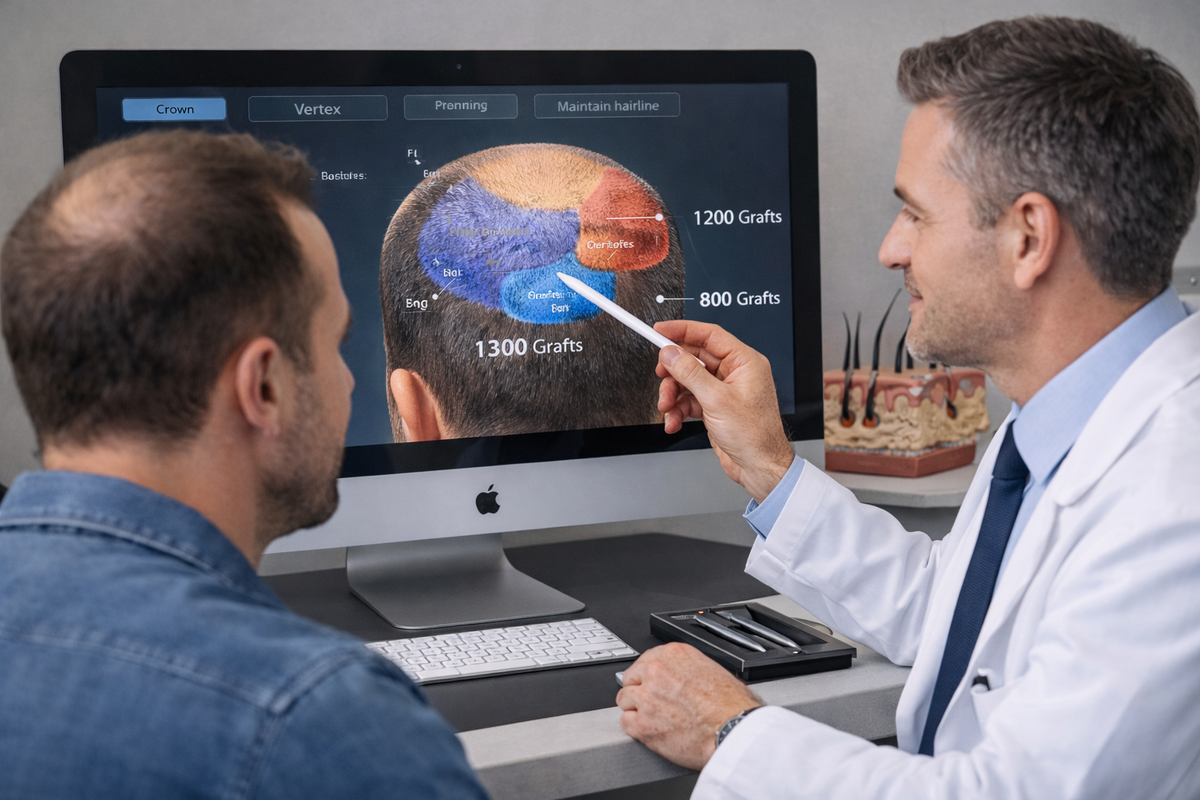
Once areas of hair loss are identified, the next step is calculating the approximate graft requirement. This is often done using a combination of visual mapping and follicular unit density estimates:
- Mark affected regions: Use scalp diagrams or interactive 3D models to select thinning or bald areas.
- Determine density needs: Decide on the desired density, measured in follicular units per square centimeter. For a natural look, typical density ranges from 30–45 grafts/cm².
- Compute total grafts: Multiply the area (cm²) by the chosen density to get a preliminary graft count.
Advanced hair calculators automate this process, factoring in hair texture, donor availability, and gender-specific patterns to provide a clinically validated graft range.
Step 3: Consider Donor Area Limitations
The donor area—the region from which hair follicles are harvested—is finite. Over-harvesting can cause visible thinning in donor regions and compromise long-term outcomes. Clinically guided calculators take donor availability into account, ensuring that the proposed graft plan is realistic and safe.
Step 4: Factor in Specialized Procedures
Hair restoration is no longer limited to scalp transplants. Modern clinics offer specialized treatments that influence graft calculations:
- FUE (Follicular Unit Extraction): Harvests individual follicular units, allowing precise placement with minimal scarring. Suitable for patients seeking a minimally invasive procedure.
- FUT (Follicular Unit Transplantation): Involves strip harvesting for higher graft yields, ideal for advanced hair loss cases.
- Beard and Eyebrow Transplants: Require careful angle and density considerations for natural facial aesthetics.
- PRP (Platelet-Rich Plasma) Therapy: Stimulates dormant follicles, improving graft survival and hair density.
- Scalp Micropigmentation (SMP): Non-surgical technique to create the illusion of fullness, which may reduce the number of required grafts.
Accurate graft estimation should incorporate these adjunct treatments to optimize results and patient satisfaction.
Step 5: Personalize and Adjust
Every patient is unique. Hair density, scalp laxity, and long-term hair loss progression must be considered. Clinically guided calculators provide a baseline, but final plans are tailored during in-person consultations with specialists. These consultations refine graft placement, adjust for patient goals, and ensure safety.
Benefits of Accurate Hair Graft Estimation
- Natural Results: Avoids sparse or unnatural-looking coverage.
- Efficient Use of Donor Hair: Prevents over-harvesting and preserves donor site integrity.
- Cost-Effective Planning: Helps patients understand graft needs, reducing unnecessary procedures.
- Personalized Treatment: Allows specialists to create customized plans based on patient-specific factors.
- Enhanced Confidence: Knowing the expected outcome reduces anxiety and builds trust in the treatment process.
Why Choose Clinically Guided Tools
Clinically guided hair graft calculators are built on evidence, patient data, and decades of clinical experience. They remove guesswork, provide transparent methodology, and adapt to various hair types—including straight, wavy, and afro-textured hair. This ensures all patients receive accurate, realistic, and safe recommendations.
Take the Next Step
Estimating hair graft requirements is the foundation of a successful hair restoration journey. By combining advanced technology, interactive 3D visualization, and clinically guided calculations, patients can take the first step toward restoring natural-looking hair with confidence.
At ArtisticBuz, our professional hair graft calculator provides:
- Instant, accurate graft estimates
- Personalized assessment based on hair pattern and density
- Integration with consultation for a complete treatment plan
Whether you are considering a scalp, beard, or eyebrow transplant, understanding your graft requirements empowers you to make informed decisions, achieve natural results, and maintain long-term hair health.
Take the Next Step
Ready to Know Exactly How Many Grafts You Need?
Use our professional hair graft calculator for a clinically guided estimate — then speak with a specialist to turn it into a personalised treatment plan.